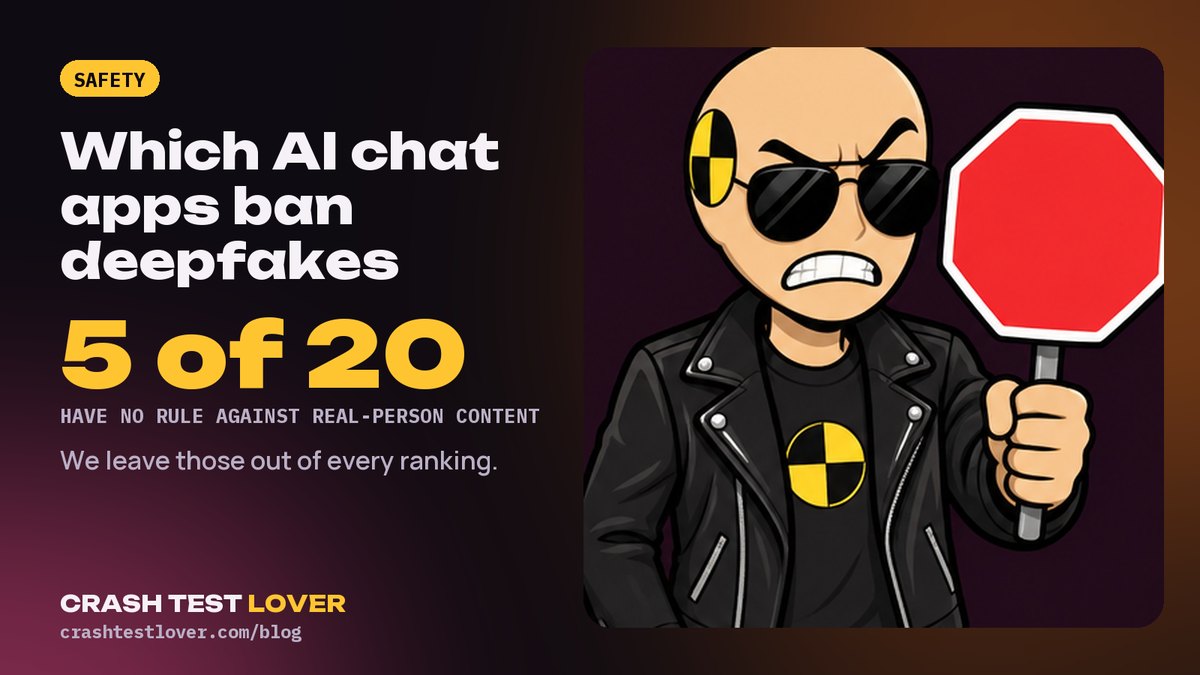
Of the 20 adult AI chat and image services I track, 11 have a written rule against sexual content or likenesses of real people, including deepfakes. Four have only a partial rule that covers celebrities, paid content or deception. Five have no such rule I could find: Kupid AI, Nomi, SoulGen, DarLink AI and Muah AI. I exclude all five from my rankings.
Everything here comes from official terms, community guidelines, content policies and help pages, checked Oct 25, 2026. This is a test drive: I read the rules, I did not try to break them, and a written rule tells you what a company promises, not how well it enforces it.
Why a written rule matters
An AI companion app that can generate images is, technically, an app that can generate images of anyone. The difference between a fantasy character and a non-consensual deepfake of a real person is a policy decision. So I look for that decision in writing.
A written ban does three things for you:
- It protects other people. Sexual images of a real person made without consent are a serious harm to that person, whether they are a celebrity, a streamer, or someone’s ex. In a growing number of places it can also be illegal. I am not a lawyer, so check your own country’s rules, but “the app let me” is not a defence anyone should test.
- It protects you. A service that allows real-person content is a service whose image database is a liability. If it is breached, subpoenaed or shut down, you don’t want to be in that database.
- It gives a removal path. A service with a rule usually has a way to report and take down content. A service without one has nothing to point to.
That is why I made it a hard line. Services with no written rule against sexual content of real people get mentioned as warnings, never recommended. It is also one of the ten items in my paper check.
The full table
“Full ban” means the rule covers real people in general, including private individuals, and names sexual content, intimate images or deepfakes. “Partial” means the rule is limited to celebrities, paid content or deceptive impersonation. “None found” means I found no rule on real people beyond generic bans on illegal use or impersonation. All checked Oct 25, 2026.
| Service | Rule on real people | What it covers | In my rankings? |
|---|---|---|---|
| Candy.ai | Full ban | Images that resemble real persons, non-consensual intimate imagery, impersonation | Yes |
| Secrets AI | Full ban | Sexual content of identifiable real people, deepfakes, lookalikes; no uploads | Yes |
| OurDream AI | Full ban | Content resembling real people incl. celebrities; voice deepfakes; no reference photos | Yes |
| Promptchan | Full ban | Non-consensual deepfake porn; celebrities and private people without consent | Yes |
| Swipey AI | Full ban | Any real identifiable person without consent, intimate imagery, deepfakes | Yes |
| Kindroid | Full ban | Using a person’s likeness; intimate images of a real person incl. AI-generated | Yes |
| Nectar AI | Full ban | Porn of real persons or lookalikes; characters based on real people | Yes |
| SpicyChat | Full ban, with a carve-out | Real photos, AI portraits of real people, deepfakes; public figures may inspire bots | Yes |
| JanitorAI | Full ban, with a carve-out | Real private people and deepfakes; well-known celebrities may be depicted | Yes |
| DreamGF | Full ban | Content resembling real individuals deleted; removal request process | Yes |
| GirlfriendGPT | Full ban | Uploading images of others without consent, intimate material, impersonation | Yes |
| Lovescape | Partial: celebrities only | Companions resembling celebrities or public figures | Yes, gap noted |
| CrushOn.AI | Partial: paid content | Non-consensual depictions of real people in creators’ Paid Content | Yes, gap noted |
| Dream Companion | Partial: deception | Deceptive impersonation; consent for uploaded media | Yes, gap noted |
| Chub AI | Partial | Real photos “frowned upon”, removed if illegal; revenge porn removed | Yes, gap noted |
| Kupid AI | None found | Generic illegal-use ban and rights complaints | No |
| Nomi | None found | Bans impersonation and harassment only | No |
| SoulGen | None found | Bans privacy or publicity violations; deepfakes not named | No |
| DarLink AI | None found | Bans pretending to be a celebrity; offers influencer personas | No |
| Muah AI | None found | Guide says to use images you have permission to use | No, never recommended |
The services with a full ban
These eleven have rules I’d call adequate on paper. The wording varies, and the details matter.
Secrets AI has the most thorough setup. Its Prohibited Content Policy bans sexual content depicting identifiable real individuals without verified consent, including deepfakes and content resembling a specific real person. File and image uploads are not supported at all. Its image docs say a privacy check flags references that appear to show a real person, and prompts can be stopped for “a real person’s likeness”. That is a rule plus a mechanism.
OurDream AI bans content designed to resemble, depict or impersonate real individuals, public figures and celebrities included, without consent. Its terms also ban voice deepfakes. Its help centre says uploading reference photos is not allowed “due to possible deepfakes”.
Candy.ai bans creating or sharing “images that resemble real persons” in its community guidelines, along with non-consensual intimate imagery and impersonation.
Promptchan bans non-consensual deepfake pornography and depicting or impersonating celebrities, public figures or private individuals without explicit, verifiable consent. As an image-first service, this rule matters more here than on a text chat site.
Swipey AI prohibits creating or depicting any real, identifiable person without consent, including intimate imagery and deepfakes. Users can’t upload their own images. Swipey also runs “Fanclubs” of AI versions of real creators; the rule says “without consent”, so these are presumably consented, but the terms I read don’t explain how consent is handled.
Kindroid bans appropriating a person’s name, likeness or persona without permission, except for things like commentary or non-commercial parody, and bans intimate images of a real person without consent, including AI-generated or altered ones.
Nectar AI bans pornographic content of “real persons or similarity to”. Its FAQ adds that characters based on recognisable real individuals, whether celebrities, public figures or private persons, are prohibited. Image uploads in character creation are not permitted.
DreamGF says content “made to resemble real individuals or minors will be deleted”, and it has a separate process for requesting removal of AI content that resembles a real person. A takedown route for the person depicted is rarer than it should be.
GirlfriendGPT bans impersonation, “uploading images of others without their consent” and non-consensual intimate material. Its terms add that using a celebrity’s name or likeness without consent may infringe their publicity rights and will be acted on. Even so, its character browser has a “Celebrity” category tag, so celebrity-themed characters appear to be allowed.
Two have carve-outs worth knowing:
- SpicyChat bans real photos, AI portraits resembling actual people, deepfakes and sexual depictions of real identifiable persons. Bots based on private or lesser-known people are banned. But public figures may “inspire” bots unless they have said they don’t want to be sexualised.
- JanitorAI bans content depicting real private individuals, including AI likenesses and deepfakes. Content creators, influencers, streamers and sex workers may not be depicted in any way. But widely recognised celebrities may be depicted.
Both carve-outs are about text characters inspired by famous people, not about images of them. I still count these as full bans because private people and deepfakes are clearly covered, but if celebrity-themed bots bother you, know they are allowed.
Partial rules: celebrities only, or paid content only
These four have some rule, which is better than none, but it leaves a gap. I list them, with a warning.
Lovescape bans creating companions that closely resemble real-world celebrities or public figures, and says moderation automatically flags celebrity names and images. Its help centre says “real-person replication is not supported”, and users can’t upload their own photos for public viewing. What the terms don’t explicitly cover is a private person: a neighbour, a co-worker, an ex. The help centre line points the right way, but it isn’t a rule in the terms.
CrushOn.AI restricts “non-consensual depictions of real people” in creators’ Paid Content, and warns that using a celebrity’s likeness without permission risks publicity-rights claims. The rule as written covers content sold on the platform, not everything users make.
Dream Companion bans falsely representing individuals, celebrities or public figures “with intent to deceive”, and requires consent from everyone depicted in uploaded media. The deception wording is the weak spot: a sexual image of a real person doesn’t have to deceive anyone to hurt them. There is no explicit deepfake ban.
Chub AI says real photos of real people are “frowned upon” and removed if illegal. Administrators delete projects containing revenge porn or harassment of real people. That is a floor, not a ban.
Services with no rule
Five services have no written ban on sexual content of real people that I could find. They are out of my rankings. You can still read their test drives, which carry the same warning.
- Kupid AI: the terms don’t mention real people or deepfakes. They ban illegal use and provide a process for reporting content that infringes rights such as image rights, plus appeals for people depicted in removed content. Kupid also names no legal entity or address.
- Nomi: no real-person or deepfake clause. The terms prohibit impersonating another person and using content to harass, deceive or defame. Nomi generates selfies and art, and can view images you send.
- SoulGen: an image and video generator whose terms ban content “invasive of personal privacy or publicity rights” but never name deepfakes or celebrities. Its terms also have no 18+ requirement I could find, which is a separate problem.
- DarLink AI: the terms forbid pretending to be a celebrity and posting others’ identifying information. No rule on generating sexual imagery of real people. DarLink itself sells influencer-specific AI persona subscriptions.
- Muah AI: no real-person rule in its terms. Its guide only says to use adult fictional characters and images you have permission to use, and its character creator works from an uploaded image. Add the September 2024 breach, which Have I Been Pwned says exposed about 1.9 million email addresses together with AI prompts, and I won’t recommend it under any circumstances.
Some of these have reasonable prices or features, which is the point. A good feature list doesn’t fix a missing rule.
What a rule does not prove
A written ban is necessary, not sufficient. Things I can’t verify from the outside:
- Enforcement. I haven’t tried to generate prohibited content, and I won’t. A ban that the filters don’t enforce is just text.
- Uploads. The strongest protection is not accepting photos of people at all. Secrets AI, Swipey AI and Nectar AI say they don’t allow uploads, and OurDream AI bans reference photos. Lovescape restricts uploads to avatars.
- Takedown speed. DreamGF and Kupid AI describe removal processes. None of the policies in my research files promise a response time for takedowns.
User reports occasionally touch moderation of this kind. A Trustpilot reviewer of CrushOn.AI alleges that roleplay with characters presented as minors is possible. That is one user’s allegation and I haven’t verified it, but it is a reminder that rules and filters are different things.
How to check a service yourself
If an app isn’t on my list, here is what to look for in under five minutes:
- Find the content policy. Look for “Prohibited Content”, “Community Guidelines” or “Acceptable Use” in the footer, not just the terms of service.
- Search for “real”. You want wording like “real person”, “identifiable individual”, “likeness” or “deepfake”. “Celebrity” alone is not enough.
- Check for private people. The rule should cover anyone, not only public figures.
- Check uploads. Can you upload a photo to make a character? If so, the rule matters even more.
- Look for a takedown route. Can someone who finds themselves depicted ask for removal?
For services that pass, see best AI girlfriend apps and best NSFW AI chat. For the other half of the safety picture, read what AI girlfriend apps do with your chats.
FAQ
Which AI girlfriend apps ban deepfakes?
As of Oct 25, 2026, Candy.ai, Secrets AI, OurDream AI, Promptchan, Swipey AI, Kindroid, Nectar AI, SpicyChat, JanitorAI, DreamGF and GirlfriendGPT have written rules against sexual content or likenesses of real people, including deepfakes. SpicyChat and JanitorAI allow some celebrity-inspired characters, and GirlfriendGPT has a "Celebrity" category tag.
Does Nomi allow images of real people?
Nomi's terms have no specific rule on real people or deepfakes that I could find. They ban impersonation, harassment, deception and defamation. Because there is no written real-person ban, Nomi is excluded from my rankings. See the Nomi test drive.
Is it illegal to make AI images of real people?
It depends on where you live and what the images show. Sexual deepfakes of real people made without consent are illegal in a growing number of places. I'm not a lawyer; if you're unsure, don't make them. Most of the services in my rankings ban them anyway.
Why is Muah AI not on your list?
Muah AI has no rule against sexual content of real people in its terms, and in September 2024 it was breached. Have I Been Pwned says the breach exposed about 1.9 million email addresses together with AI prompts. I don't recommend it.
Can I upload a photo of myself to an AI girlfriend app?
On several of the strictest services, no. Secrets AI says uploads aren't supported, Nectar AI doesn't allow images in character creation, Swipey AI doesn't allow user uploads, and OurDream AI bans reference photos because of possible deepfakes.